
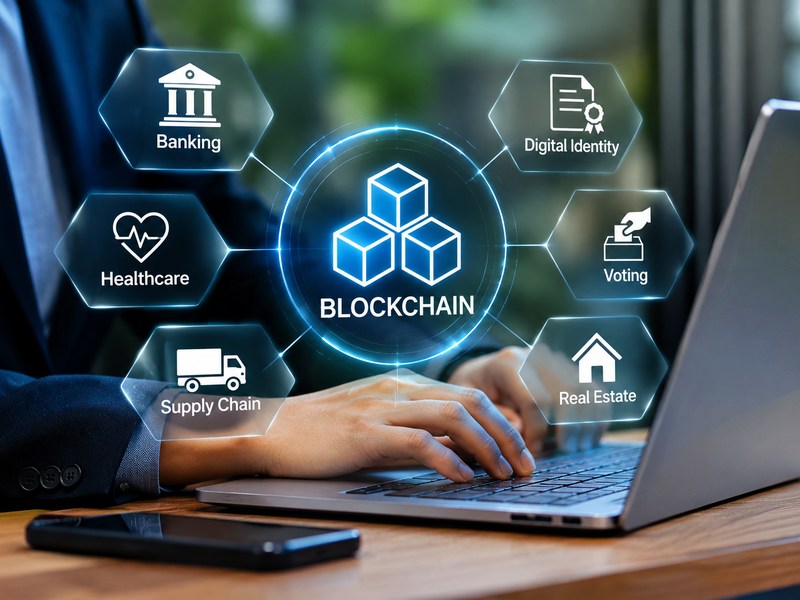
Blockchain is a shared digital record book (a ledger) that many computers keep copies of, where new entries are added in linked blocks and cannot easily be changed or deleted. Cryptocurrencies such as Bitcoin were its first use, but the same technology is also used for tracking goods in supply chains, settling payments, recording ownership, verifying documents and credentials, and sharing data between organizations that do not fully trust each other. It is useful where trust, transparency and a tamper-resistant history matter, but it is not the best tool for every problem.
Blockchain at a Glance
| Question | Short answer |
|---|---|
| What is it? | A shared, append-only digital ledger spread across many computers |
| How does it stay secure? | Cryptography, linked blocks and agreement between participants (consensus) |
| Is blockchain the same as Bitcoin? | No. Bitcoin is one application built on a blockchain |
| Main benefits | Tamper resistance, transparency, traceability, fewer middlemen |
| Main limits | Cost, speed, energy use in some designs, privacy and legal questions, complexity |
| Real uses beyond crypto | Supply chains, payments, tokenized assets, identity, records, healthcare, voting pilots |
| Biggest myth | That blockchain is always the right answer. Often a normal database is better |
How Does Blockchain Work?
- A transaction or record is created, such as a payment, a shipment scan or a document hash.
- It is sent to a network of computers (nodes) that each hold a copy of the ledger.
- The network checks it using agreed rules.
- Valid records are grouped into a block.
- The nodes agree on the block through a consensus method, such as proof of work or proof of stake in public networks.
- The block is linked to the previous one using a cryptographic fingerprint called a hash, forming a chain.
- The record becomes very hard to change, because altering one block would change its hash and break the links that follow, and the other copies would reject it.
Smart contracts are programs stored on some blockchains that run automatically when conditions are met, such as releasing a payment when a shipment is confirmed.
Types of Blockchains
| Type | Who can join | Typical use |
|---|---|---|
| Public | Anyone | Cryptocurrencies, open applications |
| Private | One organization controls access | Internal record keeping |
| Consortium | A group of approved organizations | Industry networks, such as banks or supply chains |
| Hybrid | Mix of public and private parts | Systems that need both transparency and privacy |
Most business uses beyond crypto use private or consortium blockchains, or use a public chain only to anchor proofs.
Why Blockchain Matters Beyond Crypto
Blockchain is helpful when several parties need to share one version of the truth and no single party should be able to edit the history alone. Its strengths are:
- Tamper resistance: records are hard to alter without detection.
- Shared record: all approved participants see the same data.
- Traceability: each step in a process can be tracked over time.
- Automation: smart contracts can handle routine steps without manual checks.
- Fewer intermediaries: in some cases it can reduce delays and paperwork.
Real-World Uses of Blockchain Beyond Crypto
1. Supply Chain and Food Traceability
Blockchain can record each step of a product’s journey, from farm or factory to store shelf. Large retailers and food companies have tested it to trace produce and other goods, so that if there is a contamination issue, they can find the source faster. It is also used for tracking diamonds, coffee, seafood and luxury goods, and for proving where items come from. The records are only as good as the data entered, so sensors, scans and honest reporting still matter.
2. Banking, Payments and Settlement
Banks and payment firms use blockchain-based systems to speed up cross-border payments, settle trades and manage collateral. Some use private networks, while others use public blockchains with regulated tokens such as stablecoins for payments. Central banks around the world are also researching or piloting digital currencies, and the progress and rules differ by country.
3. Tokenized Real-World Assets
Tokenization means representing an asset, such as a fund, bond, property or invoice, as a digital token on a blockchain. Large asset managers and banks have launched tokenized money market funds and bonds, with the goal of faster settlement, lower costs and easier transfer. Rules and investor protections vary by country, and the market is still early.
4. Digital Identity and Credentials
Blockchain can be used to verify digital credentials such as degrees, certificates and licenses. An organization can record a fingerprint of a credential on a blockchain, and an employer can check that it is real without calling the school. Some digital identity projects let people control their own credentials and share only the details needed, an approach known as self-sovereign identity.
5. Healthcare and Medical Records
Healthcare organizations have explored blockchain for tracking drug supply chains to fight counterfeit medicines, verifying clinical trial data and managing consent for sharing records. Privacy law is a major concern, so sensitive health data is normally kept off the blockchain, with only proofs or access records stored on it.
6. Land Records and Property
Some governments and organizations have run pilots that record land titles and property transfers on a blockchain to reduce fraud and disputes. These projects only work when the original records are accurate and when law and administration support the system.
7. Voting and Public Services
Blockchain has been tested for voting pilots and public records. Security experts are cautious about online voting in general, and most large elections do not use blockchain. Treat claims about secure blockchain voting carefully.
8. Intellectual Property, Media and Royalties
Creators and companies use blockchain to timestamp work, track licensing and automate royalty payments through smart contracts. Digital ownership tokens (NFTs) were an early example, and the market has been volatile, so utility and legal rights matter more than hype.
9. Energy and Sustainability
Blockchain pilots track renewable energy certificates, carbon credits and peer-to-peer energy trading, so that credits are not counted twice. Quality depends on the underlying measurements and verification.
10. Insurance and Smart Contracts
Insurers have tested automated payouts through smart contracts, such as paying a flight delay claim when a trusted data source confirms the delay. This reduces paperwork, but the system still depends on reliable data.
11. Gaming and Digital Goods
Some games use blockchain to let players truly own and trade items. Adoption has been mixed, and many players are cautious about speculation and costs.
Blockchain vs a Regular Database
| Feature | Blockchain | Regular database |
|---|---|---|
| Control | Shared among participants | One owner or administrator |
| Editing history | Very hard to change | Easy for the owner to edit |
| Speed and cost | Usually slower and more costly | Fast and cheap |
| Trust needed | Lower trust between parties needed | Requires trust in the owner |
| Privacy | Harder, since data is shared | Easier to control |
| Best for | Multi-party records that need a shared, tamper-resistant history | Most applications inside a single organization |
Rule of thumb: if one trusted organization can run the system, a normal database is usually simpler, faster and cheaper. Consider blockchain only when several parties who do not fully trust each other need to share and rely on the same record.
Limits and Challenges of Blockchain
- Cost and complexity: building and running blockchain systems can be more expensive than traditional systems.
- Speed and scale: many networks process fewer transactions than centralized systems, though newer designs are improving.
- Energy use: proof-of-work networks use a lot of electricity, while proof-of-stake and private networks use far less.
- Garbage in, garbage out: a blockchain can prove that data was not changed, but it cannot prove that the data was correct when it was entered.
- Privacy and regulation: immutable records can conflict with privacy laws such as the right to erasure, so personal data should be handled carefully.
- Interoperability: different blockchains do not always work together easily.
- Security risks: the chain itself can be strong, but smart contract bugs, key theft and scams cause real losses.
- Hype: many projects have been announced and later dropped, because simpler tools solved the problem.
How to Evaluate a Blockchain Project
- What problem does it solve, and could a regular database do the same?
- Who are the participants, and do they need a shared record?
- Who controls the system, and who can change the rules?
- How is the data checked before it is recorded?
- How is privacy handled, and does it follow the law?
- What are the costs and benefits compared with the current process?
- Is there real adoption, or only announcements?
- Is it regulated or backed by trusted institutions, where that matters?
Blockchain in India
India has explored blockchain in areas such as digital credentials, land records pilots, supply chain tracking, trade finance and government services, and the Reserve Bank of India has run pilots of a central bank digital currency, the digital rupee. Crypto assets are subject to specific taxes and rules in India, and regulations continue to evolve, so check the latest guidance from official sources if you plan to invest or build a business around blockchain.
Tips for Beginners
- Learn the basics before you invest in or build anything.
- Separate blockchain technology from cryptocurrency prices.
- Be careful with promises of guaranteed returns, which are a common sign of scams.
- Protect your private keys and passwords, and use trusted wallets and platforms.
- Check whether a platform is regulated in your country.
- Never invest money you cannot afford to lose.
The Future of Blockchain in 2027 and Beyond
Expect steady, practical growth rather than hype. Trends to watch include tokenization of funds, bonds and other assets, stablecoin-based payments, digital identity and verifiable credentials, better scaling and lower energy use, clearer regulation in many countries, and use alongside AI for data provenance, such as proving where content and data came from. Timelines vary, and many promised use cases will depend on regulation and real demand.
