
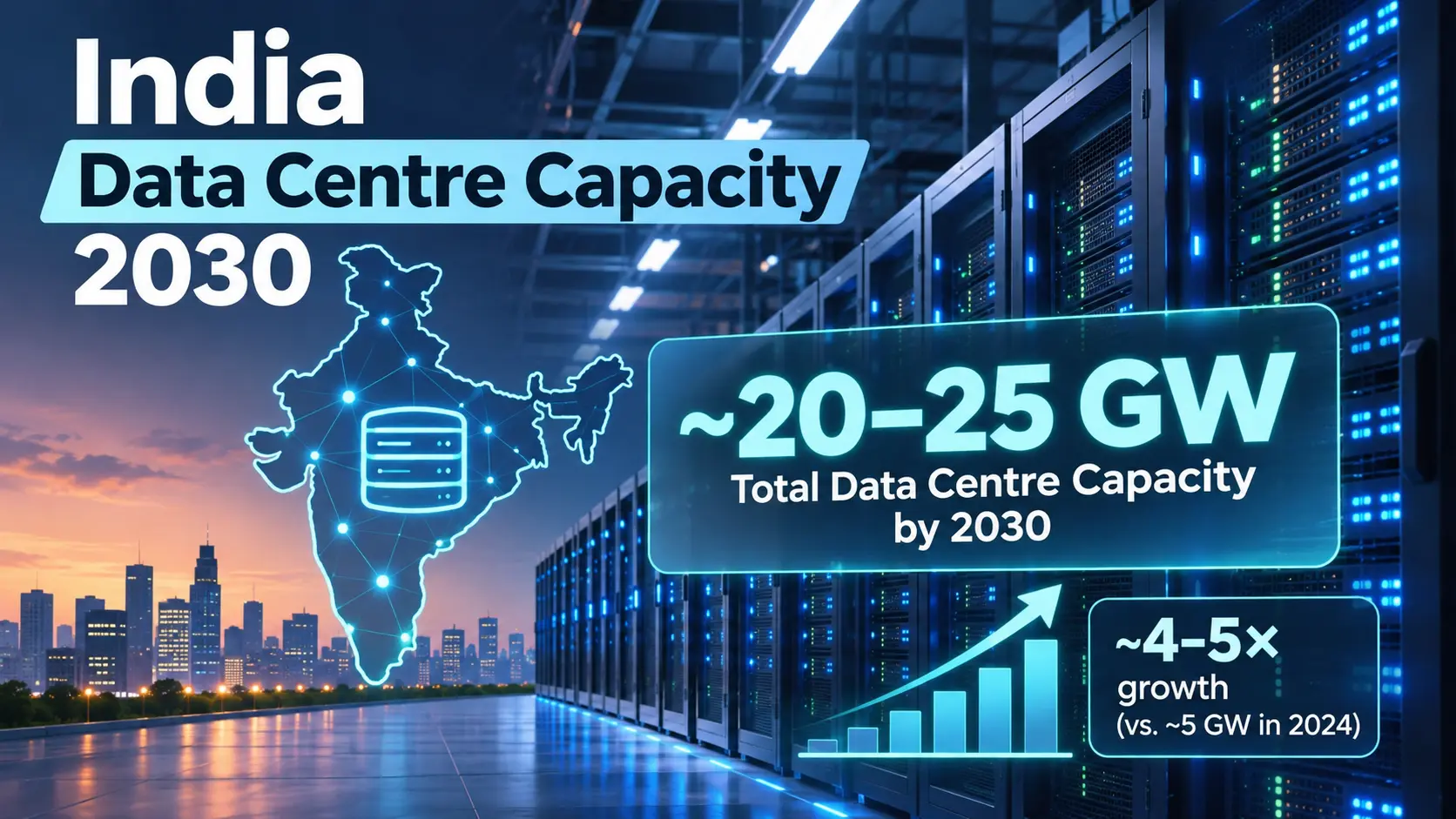
India’s installed data centre capacity is expected to rise five-fold to about 7.5 gigawatts (GW) by March 2030, according to Crisil Ratings. The build-out is being driven by generative AI, enterprise digitalisation and rising data consumption, and is expected to attract investment of more than ₹3 trillion (₹3 lakh crore) over the next four financial years.
Key numbers at a glance
| Metric | Figure |
|---|---|
| Capacity by March 2030 | About 7.5 GW (five-fold increase) |
| Investment | More than ₹3 lakh crore over four financial years |
| Upcoming capacity | About 6 GW, roughly three-fourths in Visakhapatnam, Mumbai and Hyderabad |
| Current utilisation | Around 90% |
| Under-construction capacity already contracted | More than 95% |
| Hyperscaler share of leased capacity | Rising to 75-80% by FY2030 from 60-65% in FY2026 India’s data centre capacity expected to increase five-fold by 2030 |
Why is India’s data centre capacity growing so fast?
Three forces are pushing demand at once. Generative AI workloads need far more compute, companies are moving more operations online, and everyday data use keeps climbing. Global hyperscalers are signing up capacity early, which gives developers revenue certainty and lowers the risk that new facilities sit empty. Nearly half of the upcoming capacity is already committed under long-term contracts.
Why is India attractive for data centres?
Cost is a big part of it. Development costs are about 20% lower than in several competing Asia-Pacific markets, and with lower power tariffs, rentals run 30-35% below peer markets. India’s ability to build large campuses powered by renewable energy also suits hyperscalers with sustainability targets.
Which Indian cities will see the most growth?
Visakhapatnam, Mumbai and Hyderabad are set to host the bulk of new capacity. The strain on their grids will differ. By FY2030, data centre capacity in these three cities could equal roughly 80%, 60% and 20% of their current peak electricity demand, in that order. That makes new transmission lines and grid connections the critical path for the whole build-out.
What are the risks?
- Power and approvals. Crisil says timely power connectivity, regulatory clearances and project execution will decide whether demand turns into sustainable returns.
- Customer concentration. As hyperscalers take a larger share, they gain bargaining power, which could pressure rentals and project returns.
- Heavy upfront spending. Investment typically comes 24-36 months before cash flows, so debt stays elevated in the medium term.
- Keeping up with AI. Older facilities need upgrades for higher power density and advanced cooling to stay relevant for next-generation AI workloads.
How do other forecasts compare?
Estimates vary because analysts define and count capacity differently, so compare the starting points as well as the end numbers.
| Source | 2030 outlook |
|---|---|
| Crisil Ratings (Nov 2026) | About 7.5 GW by March 2030 |
| Jefferies (Nov 2025) | Five-fold growth to 8 GW by 2030, needing about $30 billion of capex |
| Wood Mackenzie (Jul 2026) | More than five-fold, to 12 GW from 2.2 GW in 2025 |
| Vestian (Apr 2026) | About 5 GW by 2030 |
| Macquarie (Oct 2025) | Double by 2027, and five-fold by 2030 if the pipeline is fast-tracked India’s data centre capacity expected to increase five-fold by 2030 |
The range of 5 to 12 GW is wide, but every major forecaster expects steep growth.
What does this mean for businesses and consumers?
For companies, more local capacity should mean more choice and competitive pricing for cloud and AI hosting. For the grid, Macquarie projects data centres could use 1.9-3.2% of India’s electricity by 2030, up from 0.8% in 2024. Power planning is where the next bottleneck will show up.
Frequently Asked Questions
Crisil expects about a five-fold rise to roughly 7.5 GW by March 2030. Other forecasters range from about 5 GW to 12 GW.
Crisil expects more than ₹3 lakh crore over the next four financial years.
Visakhapatnam, Mumbai and Hyderabad together are expected to host about three-fourths of upcoming capacity.
Power connectivity and approvals, followed by dependence on a few large hyperscaler customers.
They sign long-term contracts before facilities open, which reduces risk for developers but increases their bargaining power over time.
