
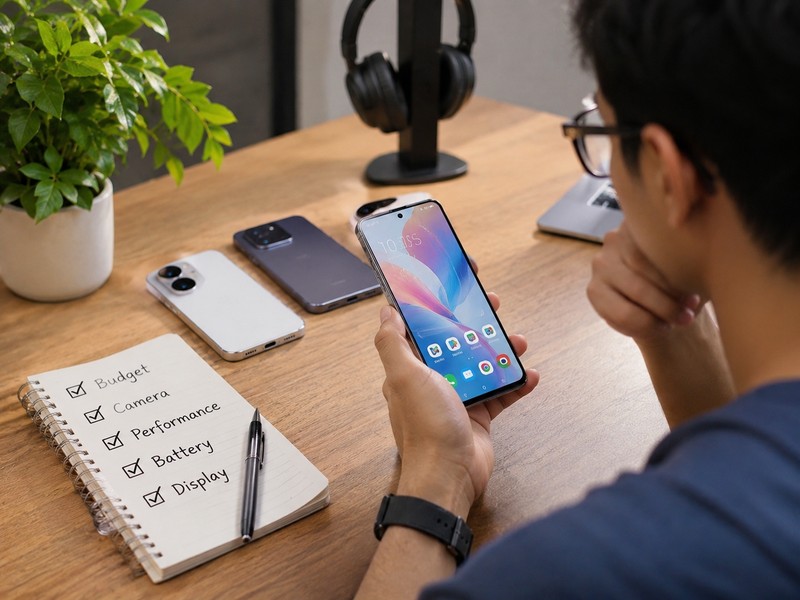
How Do You Choose a Smartphone in 2027?
Start with your budget, then pick an operating system (iPhone or Android), then compare update support, display, battery, camera and processor in that order. Software update length and battery life matter more over the years than raw speed. Read long-term reviews, check the return policy, and buy during a sale if you can.
Step-by-Step Checklist
- Set a realistic budget, including a case, a screen protector and any trade-in value.
- Choose iPhone or Android based on your ecosystem and habits.
- Check how many years of software and security updates are promised.
- Pick a processor that fits how you use the smartphone.
- Choose the display type, size and refresh rate you prefer.
- Compare battery size and charging speed.
- Judge the camera by real photo and video samples, not megapixels.
- Check 5G support, storage and RAM.
- Read reviews and compare the final price across stores.
1. Set Your Budget First
Your budget decides which brands and features are realistic, so fix it before you read any specs.
| Budget level | What to expect |
|---|---|
| Entry-level | Good for calls, messaging, social media and video. Basic cameras and shorter update support. |
| Mid-range | Best overall value. AMOLED screens, fast charging, good cameras and smooth performance. |
| Upper mid-range | Near-flagship processors, better cameras and longer update promises. |
| Flagship | Top cameras, brightest displays, best performance and the longest support. |
A mid-range phone with 5 or more years of updates is often a better buy than a cheap phone you replace after two.
2. Choose Your Operating System: iPhone or Android
Choose iPhone (iOS) if you:
- Use a Mac, iPad, Apple Watch or AirPods
- Want simple software and long, consistent updates
- Care about resale value and privacy by default
Choose Android if you:
- Want more choice of brands, sizes and prices
- Enjoy customizing your phone
- Want faster charging, bigger batteries or a foldable
- Rely heavily on Google services and Gemini
If you are undecided, see our full iPhone vs Android comparison for 2027.
3. Check the Software Update Policy
This is the most overlooked factor. A phone that stays secure and gets new features for 5 to 7 years saves you money in the long run.
- Apple supports iPhones for many years across its lineup.
- Google and Samsung promise up to seven years of updates on their latest flagships.
- Many other Android brands offer 2 to 4 years, especially on budget phones.
Always look for both Android version updates and security patches, since they are often promised separately.
4. Pick the Right Processor
You do not need the fastest chip unless you game, edit video or keep your phone for a long time.
- Everyday use (calls, social media, video, UPI and banking apps): a modern mid-range chip is enough.
- Gaming and heavy multitasking: choose a flagship or near-flagship processor with good cooling.
- Long-term use: a stronger chip stays smooth for more years as apps get heavier.
Check reviews for sustained performance and heat, not just benchmark scores.
5. Choose the Right Display
- Panel type: OLED or AMOLED gives deeper blacks, better colors and better outdoor visibility than LCD.
- Refresh rate: 90Hz is good, 120Hz feels very smooth, and adaptive (LTPO) refresh saves battery.
- Brightness: look for high peak brightness if you use your phone outdoors a lot.
- Size: 6.1 to 6.4 inches is compact and comfortable, 6.7 inches and above is better for video and gaming.
- Protection: a good glass and an IP rating (IP67 or IP68) protect against drops, dust and water.
6. Battery Life and Charging
- Aim for 5,000 mAh or more on Android phones. iPhones manage battery differently and often last as long with smaller capacities.
- Check charging speed and whether a charger is in the box, since many brands no longer include one.
- Look for wireless charging if it matters to you, and check for battery health features that protect the battery over time.
Real battery tests in reviews tell you more than the capacity number alone.
7. Camera: What Really Matters
Megapixels are a poor guide. Judge a phone camera by:
- Main sensor quality and image processing, which decide most of your photos
- Low-light performance, which separates good phones from great ones
- Video quality and stabilization, especially if you shoot a lot of video
- Zoom, where a real telephoto lens beats digital zoom
- Front camera, if you take selfies or make video calls
Look at side-by-side sample photos in at least two independent reviews before you decide.
8. Storage, RAM and Connectivity
- Storage: 128 GB is the minimum, and 256 GB is safer if you shoot video or keep many apps. Most phones no longer have memory card slots.
- RAM: 6 to 8 GB is enough for most people, and 12 GB or more helps heavy multitaskers.
- 5G: make sure the phone supports the bands used by your carrier in your country.
- Other features: check for eSIM or dual SIM, Wi-Fi 6 or newer, NFC and a good fingerprint or face unlock.
9. AI Features: Useful or Just Marketing?
AI features such as call screening, live translation, photo editing, summaries and smart search are now selling points. Check which AI features run on the device and which need an internet connection, how long the brand promises to support them, and whether any are locked behind a subscription. Pick a phone for its hardware and update support first, and treat AI features as a bonus.
10. Design, Build and Repairability
Metal or glass frames feel premium, while plastic backs are lighter and cheaper. Check for IP ratings, and consider how easy and cheap it is to replace the screen or battery, because repair costs add to the real price of the phone.
Choosing a Smartphone in India: What Is Different?
India is one of the most competitive smartphone markets in the world, which gives buyers excellent value but also some extra things to watch. The sweet spot for most Indian buyers is between ₹15,000 and ₹35,000, where brands such as Redmi, Realme, Poco, iQOO, Motorola, Samsung, Nothing and OnePlus compete hard on AMOLED screens, big batteries and fast charging.
Make sure the phone supports the 5G bands used by Jio and Airtel (n78 and n28 are the important ones), buy only models sold officially in India with a GST invoice and warranty, and check that the brand has service centers near you, especially outside the big cities.
Look closely at the update promise and the amount of preinstalled apps and ads, as both vary a lot in budget phones. Festive sales such as Amazon Great Indian Festival and Flipkart Big Billion Days around Diwali bring the best discounts, and bank offers, exchange bonuses and no-cost EMI can lower the price further, but compare the final price with offline stores before you pay.
iPhones are assembled in India and sold through Apple stores and major retailers, and an older model on sale is often a smart long-term buy for those who want strong update support and resale value.
Common Mistakes to Avoid
- Buying on megapixels or RAM numbers alone
- Ignoring the software update promise
- Choosing a phone without checking 5G support on your network
- Paying full price when a sale is a few weeks away
- Skipping reviews that cover battery life and heat after weeks of use
- Buying from unofficial sellers or grey-market imports
Final Tips Before You Buy
- Compare the same model across at least three stores, online and offline.
- Check the return and replacement policy.
- Look at the trade-in value of your current phone.
- Wait for a new launch if your current phone still works, since the previous model usually gets cheaper.
- Buy a good case and screen protector to protect your investment.
Frequently Asked Questions
Look at software update length, display quality, battery life, camera quality and processor, in that order, after you have fixed your budget and chosen iPhone or Android.
6 to 8 GB of RAM and 128 to 256 GB of storage cover most users. Choose more if you game, edit video or keep your phone for many years.
It is worth it if you want the best camera, display and long-term support, or plan to keep the phone for 5 or more years. Otherwise a good mid-range phone gives better value.
A good phone with a long update promise can last 5 to 7 years, and a battery replacement can extend that further.
It is strongly recommended. Most new phones support it, and it future-proofs your purchase as networks expand. Check that it supports your carrier's bands.
