
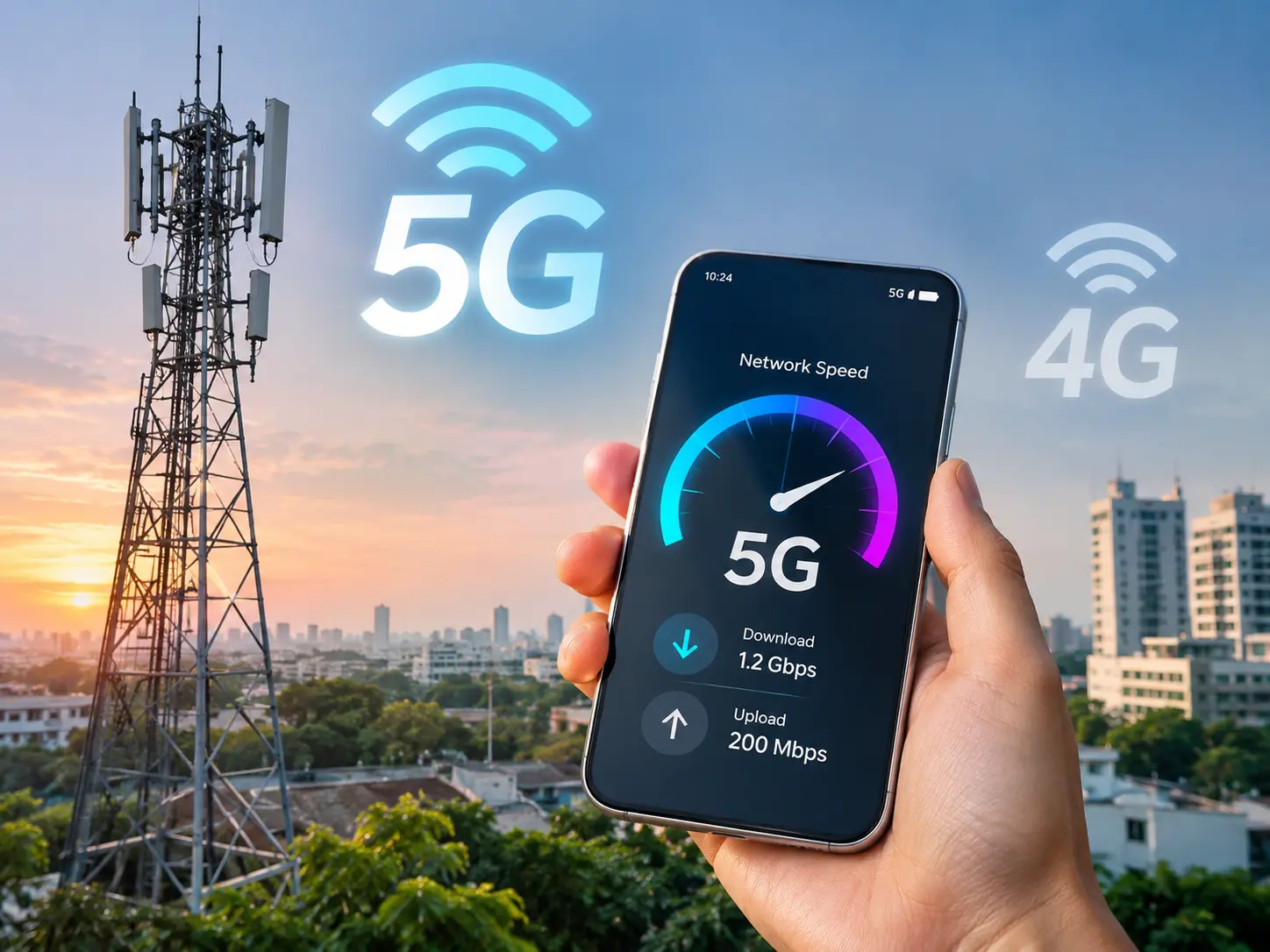
5G is the fifth generation of mobile network technology, designed to deliver faster speeds, lower latency (delay) and the capacity to connect far more devices than 4G. In real-world use, 5G is commonly several times faster than 4G, with typical speeds ranging from around 100 Mbps to over 1 Gbps depending on the network, the band and your location, while 4G usually delivers tens of Mbps. You need a 5G-compatible phone, a 5G plan and coverage in your area to use it.
5G vs 4G at a Glance
| Feature | 4G (LTE) | 5G |
|---|---|---|
| Typical real-world download speed | Roughly 10 to 50 Mbps | Roughly 100 Mbps to over 1 Gbps, depending on band |
| Theoretical peak speed | Around 1 Gbps (LTE-Advanced) | Up to 20 Gbps (design target) |
| Latency | About 30 to 50 ms | Often 10 to 30 ms today, with a design goal of around 1 ms |
| Device capacity | Limited in crowded areas | Designed for up to about 1 million devices per square kilometer |
| Frequencies | Mostly below 3 GHz | Low, mid and high (mmWave) bands |
| Best for | Streaming, browsing, calls | Fast downloads, cloud gaming, 4K and 8K video, smart devices, real-time apps |
| Network design | Mostly a single type of service | Flexible, supports network slicing in standalone mode |
The figures above are approximate and vary by country, carrier and conditions.
How Does 5G Work?
5G uses radio waves, like earlier generations, but it uses new technology to carry more data with less delay.
- Your phone connects to a nearby cell site or small cell using radio waves in a 5G frequency band.
- The cell site connects to the carrier’s core network, which routes your data to the internet.
- Advanced antennas (massive MIMO) use many antenna elements to send and receive more data streams at once.
- Beamforming points the signal toward your device instead of broadcasting in all directions, which improves speed and reliability.
- Small cells in busy areas add capacity, especially for higher frequencies that travel short distances.
- Edge computing can process data closer to you, which reduces delay for applications that need fast responses.
The Three 5G Frequency Bands
The band a 5G network uses has a big effect on speed and coverage.
| Band | Frequency range | Speed | Coverage | Typical use |
|---|---|---|---|---|
| Low-band | Below 1 GHz | Modest, a bit faster than good 4G | Wide area, good indoors | Nationwide and rural coverage |
| Mid-band (sub-6 GHz) | About 1 to 6 GHz | Fast, often several hundred Mbps | Good balance across cities and suburbs | Main 5G layer in most countries |
| High-band (mmWave) | About 24 GHz and above | Very fast, can exceed 1 Gbps | Short range, blocked by walls and trees | Stadiums, airports, dense city areas |
Most people use mid-band 5G for everyday use, because it balances speed and coverage best.
Non-Standalone (NSA) vs Standalone (SA) 5G
- Non-standalone (NSA) 5G uses the existing 4G core network with a 5G radio network. It was the faster way for carriers to launch 5G, and it improves speed but does not unlock every 5G feature.
- Standalone (SA) 5G uses a dedicated 5G core network. It enables lower latency, network slicing and better efficiency, and it is where the full potential of 5G is expected to come from.
Some carriers have moved to standalone 5G, while others are still rolling it out or running both, so what you get depends on your carrier.
Key Benefits of 5G
- Faster downloads and uploads, such as getting a movie or app update in seconds or minutes
- Lower latency, which helps video calls, online gaming and cloud services feel more responsive
- Better performance in crowded places, like stadiums, events and busy city centers
- Support for many connected devices, including smart home gadgets, sensors and wearables
- Home internet alternatives, since 5G fixed wireless access can serve homes without fiber or cable
- New services, such as network slicing for businesses, smart factories, connected vehicles and remote operations
Real-World Uses of 5G
- Streaming and gaming: smooth 4K video, cloud gaming and fast game downloads
- Video calls and live streaming: more stable high-quality video
- Smart homes and cities: connected cameras, sensors, meters and traffic systems
- Healthcare: remote monitoring and faster sharing of large medical images, with remote procedures as a longer-term goal
- Manufacturing and logistics: private 5G networks for factories, ports and warehouses
- Transport: connected and driver-assistance vehicles
- Fixed wireless access: 5G home broadband in areas where wired options are limited
Limits and Drawbacks of 5G
- Coverage is uneven. The fastest bands cover small areas, and rural and indoor coverage may be weaker.
- Real-world speeds are lower than headlines. Speeds depend on band, distance, congestion, device and plan.
- Battery use can be higher, especially in areas with weak or switching signals, although newer phones manage this better.
- You need a compatible phone and plan, and some carriers charge more for 5G.
- Not every 5G phone supports every band, so check that your phone works with your carrier’s bands.
- Cost for carriers to build the network can affect how fast it spreads.
Is 5G Safe?
5G uses non-ionizing radio waves, which do not have enough energy to damage DNA like X-rays do. International bodies such as the International Commission on Non-Ionizing Radiation Protection (ICNIRP) set exposure limits, and the World Health Organization and major health agencies say that, based on current evidence, exposure below those limits has not been shown to cause health problems. Research continues, so check the latest guidance from your national health authority if you have concerns.
Do You Need a 5G Phone in 2027?
Most new phones, including many affordable models, now support 5G, so it is easy to get. Consider 5G if:
- Your area has good 5G coverage from your carrier
- You download and stream a lot, or work on the move
- You plan to keep the phone for 3 to 5 years, since networks will keep improving
- You want your phone to be ready for future network features
If you live where only 4G is available, or you mostly use Wi-Fi, 4G is still fine for basic use, but a 5G phone is a safer long-term buy.
How to Check Whether You Have 5G
- Check your phone’s specs for 5G support and the bands it supports.
- Check your SIM and plan. Some carriers require a 5G-enabled plan or a SIM upgrade.
- Check the carrier’s coverage map for your home, work and travel areas.
- Look for the 5G icon in the status bar (it may appear as 5G, 5G+, 5G UC or similar, depending on the carrier).
- Turn on 5G in settings if needed: go to Settings > Network & internet (or Connections) > Mobile network > Preferred network type, and select a 5G or auto option.
- Run a speed test to see your real-world download speed, upload speed and latency.
Tips to Get the Best 5G Experience
- Choose a phone that supports your carrier’s main 5G bands.
- Use a carrier with strong mid-band 5G in your area.
- Move closer to a window or outdoors if indoor signal is weak.
- Keep your phone’s software updated, since updates often improve connectivity.
- Use an auto 5G mode if battery life drops, so the phone switches to 4G when 5G is weak.
- Check your data plan for caps, throttling and speed limits.
5G vs Wi-Fi
Wi-Fi and 5G do different jobs. Wi-Fi covers a limited area, such as a home or office, using your broadband connection. 5G is a mobile network that works wherever the carrier has coverage. Wi-Fi often gives faster and cheaper connections at home, while 5G is better on the move and can also serve as home broadband where wired internet is limited.
What About 6G?
6G is the expected next generation of mobile networks. Research and standards work is underway, and commercial launch is generally expected around 2030, but timelines and features are not final. In the meantime, 5G will keep improving through updates known as 5G-Advanced.
Frequently Asked Questions
The "G" stands for generation, so 5G means the fifth generation of mobile network technology.
In real-world use, 5G is often several times faster, with typical speeds from about 100 Mbps to over 1 Gbps compared with tens of Mbps on 4G. The difference depends on the band, network and location.
It can, especially in weak-signal areas or when the phone constantly switches between 4G and 5G. Newer phones and an auto 5G mode reduce the effect.
Yes. 5G phones work on 4G networks and earlier ones when 5G is not available.
Often not, but some carriers require a SIM upgrade or a 5G plan. Check with your carrier.
