


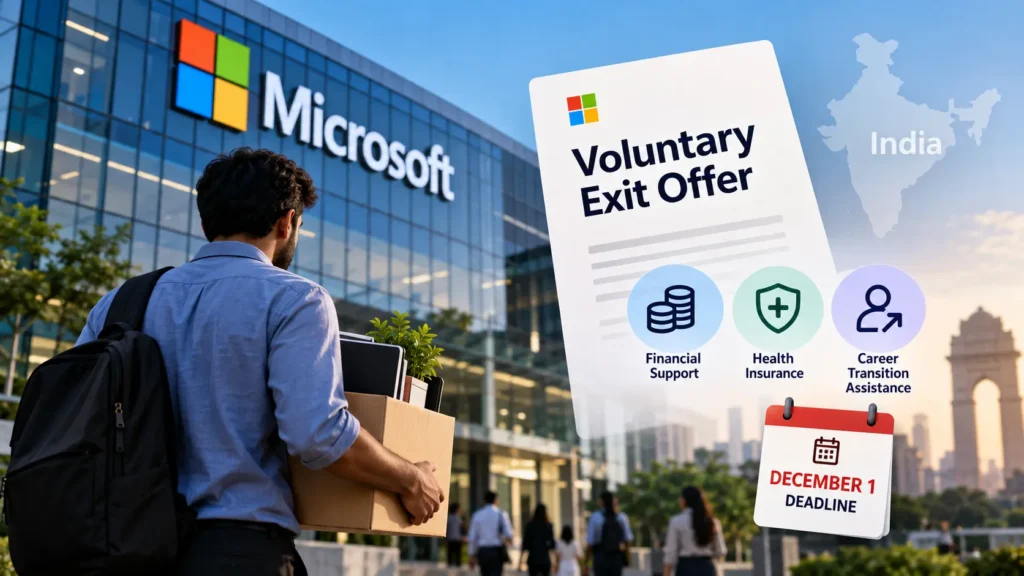
Microsoft has introduced a new Voluntary Exit Offer (VEO) for eligible employees in India and three other countries, giving workers the option to leave the company with financial support and career transition assistance. Announced on October 26, 2026, the programme comes as the technology giant continues to reshape its workforce and expand its investments in artificial intelligence (AI).
According to reports, around 60,000 Microsoft employees globally may be eligible for the offer. However, this does not mean that all eligible employees are expected to leave the company.
For employees working in Microsoft’s Indian operations, the key questions concern eligibility, severance benefits, the deadline to accept the offer, and what the programme signals about the future of technology jobs.
What Is Microsoft’s Voluntary Exit Offer?
Microsoft’s Voluntary Exit Offer is a time-limited programme that allows eligible employees in selected business divisions to leave the company voluntarily with financial support and career planning resources.
The announcement was made by Amy Coleman, Microsoft’s Executive Vice President and Chief People Officer. The company said the initiative would give employees considering opportunities outside Microsoft a supported way to transition while helping participating business units adapt to changing workforce requirements.
Unlike compulsory layoffs, a voluntary exit programme gives eligible employees a choice about whether to accept the offer. Participation is not mandatory, and the programme does not cover every employee or business division.
Microsoft has introduced the scheme across participating teams in India, the United States, the United Kingdom and Canada.
Microsoft Voluntary Exit Offer: Key Details
Here are the important details employees should know:
- Announcement date: October 26, 2026
- Countries covered: India, the United States, the United Kingdom and Canada
- Eligibility: Employees at internal job level 70 and below in participating organisations
- Deadline for Indian employees: December 1, 2026
- Expected departure date: December 31, 2026, according to published reports
- Benefits: Financial support and career transition resources, with reported severance and health insurance provisions for eligible employees in India
The exact terms may vary depending on an employee’s location, role, length of service and individual offer. Employees should refer to their official Microsoft communication for the applicable terms.
Who Is Eligible for Microsoft’s Voluntary Exit Offer in India?
The programme is available to eligible employees at Microsoft’s internal job level 70 and below, but only in participating business divisions.
Reports indicate that teams associated with Copilot, AI experiences, Windows and Devices, Xbox, finance and human resources are among the areas that may be covered. However, eligibility depends on the specific organisation and its workforce requirements.
Microsoft has not announced how many of its approximately 23,000 employees in India will receive the offer.
Employees should keep three things in mind:
- Working at Microsoft India does not automatically make someone eligible.
- The relevant business division must participate in the programme.
- The employee must receive an official communication detailing their eligibility and exit terms.
The company’s internal job levels also should not be confused with job titles alone. Employees should confirm their status through Microsoft’s internal communication rather than assuming eligibility based on seniority.
What Benefits Will Eligible Employees Receive?
The programme is intended to provide financial support and career planning assistance to employees who choose to leave.
According to published reports, the package for eligible employees in India is broadly similar to standard severance arrangements and may include:
- Severance pay: Reportedly, one month’s base salary for every completed year of service.
- Health insurance: Coverage or related provisions as specified in the employee’s offer.
- Career transition assistance: Resources to help employees plan their next professional move.
These reported benefits should not be treated as universal guarantees. Microsoft has not published a complete public schedule of individual payouts, and the official offer received by each employee is the most relevant source for the final terms.
Employees considering the offer should calculate their expected payout, review applicable tax implications and insurance coverage, and assess how long their savings could support them while they look for another role.
Why Is Microsoft Offering Voluntary Exit Packages?
The programme comes as Microsoft adjusts its workforce and invests heavily in AI infrastructure, cloud computing and AI-powered products.
Technology companies are increasingly reviewing how teams operate as AI tools automate or accelerate tasks in software development, customer service, testing and other business functions. Voluntary exit packages can help organisations manage workforce changes while offering employees financial assistance when leaving.
However, Microsoft has not explicitly stated that AI replacing human workers is the reason for this particular offer. Its official announcement describes the programme as a way to provide flexibility to employees and help participating organisations adapt to changing business needs.
Microsoft has also reiterated its commitment to India. The company has announced $20.5 billion in committed investment between 2025 and 2029 across cloud and AI infrastructure, skilling and operations.
This creates an important distinction: investment in AI can increase demand for specialised technical skills even as companies reconsider certain existing roles.
What Does the Offer Mean for India’s IT Industry?
Microsoft’s announcement highlights the broader changes taking place across the technology sector. Indian IT professionals are facing an evolving employment landscape in which AI skills, cloud expertise, cybersecurity knowledge and the ability to work with automated systems are becoming increasingly important.
The implications extend beyond Microsoft’s workforce.
- Changing job requirements: Companies may prioritise employees who can develop, deploy and manage AI-powered systems.
- Reskilling opportunities: Professionals may need to update their skills to remain competitive as technology and business requirements evolve.
- Workforce restructuring: Organisations may redesign teams, consolidate responsibilities or redirect spending towards new technology initiatives.
- Career uncertainty: Employees may face difficult decisions about job security, compensation and future employment prospects.
These trends do not mean that all traditional technology jobs will disappear. The impact of AI varies by occupation, company strategy and the complexity of the work involved. Human judgement, system architecture, security, customer relationships and specialised domain knowledge will continue to matter.
For professionals, a practical response is to build adaptable skills rather than assume that any single technology or job title guarantees long-term security.
What Should Eligible Microsoft Employees Consider Before Accepting?
Employees who receive the offer should evaluate it carefully rather than make a decision based only on the headline payout.
Here are five factors worth reviewing:
- Calculate the complete financial package. Confirm the severance amount, eligible service period, payment schedule, tax treatment and any other applicable benefits.
- Review healthcare coverage. Understand when employer-provided insurance ends and whether replacement coverage is needed.
- Assess future employment prospects. Consider current job opportunities, expected salary, notice requirements and the time likely needed to find another position.
- Check contractual and legal terms. Review the exit agreement, applicable restrictions, outstanding compensation and any obligations that continue after departure.
- Consider internal opportunities. If staying at Microsoft remains preferable, explore whether suitable internal roles or career development options are available.
Employees should also verify the exact departure date and all acceptance conditions in their official offer. Those working outside India under employment-based visas should obtain qualified immigration advice before deciding to leave.
Microsoft Voluntary Exit Offer Deadline: December 1, 2026
Eligible employees in India have until December 1, 2026, to decide whether to accept the Voluntary Exit Offer, according to published reports. Departures are expected by the end of December for employees participating in the scheme.
Employees should check their official Microsoft email and internal employee resources for the offer letter, eligibility confirmation, payout calculation and instructions for accepting or declining.
Because the programme is limited to participating organisations, employees should not assume that the same terms apply across all Microsoft teams.
Frequently Asked Questions (FAQs)
1. What is Microsoft’s Voluntary Exit Offer in India?
It is a time-limited programme that allows eligible employees in participating Microsoft business divisions to leave voluntarily with financial support and career transition resources.
2. Who is eligible for Microsoft’s voluntary exit scheme?
The offer is available to eligible employees at internal job level 70 and below in participating organisations across India, the US, the UK and Canada. Not every employee is eligible.
3. What is the last date to accept Microsoft’s exit offer?
The reported deadline for eligible employees in India is December 1, 2026. Employees should confirm the deadline stated in their individual offer.
4. How much severance pay will Microsoft employees receive?
Published reports indicate a package broadly equivalent to one month’s base salary for each completed year of service, alongside reported health insurance and career transition assistance. The exact terms must be confirmed in the employee’s official offer.
5. Is Microsoft laying off 60,000 employees?
The figure of approximately 60,000 refers to employees reportedly eligible for the global programme, not a confirmed number of employees who will leave. Participation is voluntary, and Microsoft has not publicly disclosed how many employees it expects to accept the offer.
6. Is Microsoft’s voluntary exit scheme caused by AI?
Microsoft has not explicitly attributed this programme to AI replacing employees. The offer comes amid broader workforce changes and increased AI investment across the technology industry, but the company’s stated reasons focus on workforce flexibility and changing business needs.
7. Will Microsoft’s India operations be affected?
Some eligible employees in participating Indian business divisions may receive the offer. Microsoft has not publicly confirmed the total number of Indian employees eligible or the number expected to leave.
Conclusion
Microsoft’s Voluntary Exit Offer represents another significant workforce development in the global technology industry. For eligible employees in India, the December 1 deadline makes it important to understand the financial terms, evaluate career options and make an informed decision.
For the wider IT industry, the announcement reinforces the importance of adapting to changing business priorities and advances in AI. While the long-term effects remain uncertain, technology professionals can improve their career resilience by strengthening their technical expertise, developing AI-related skills and staying open to new opportunities.
As AI continues to reshape the technology landscape, the central challenge for both employers and employees will be balancing business transformation with sustainable career growth.